
Make a free account to print · Sign in
Peek-a-Letter

Hide a capital letter under four squares. Lift them one at a time and guess the letter before it's all showing.
For grown-ups
What it builds: knowing capital letters by their shape and their name (alphabetic knowledge), even from part of a letter.
Look for: does your child say the letter's name, or point to the right card when you say it? A guess before all four squares are up shows they're using the part they can see.
Next: lift only one square and see if they can guess from that one bit. Then match each capital to its small letter.
Sky, Grass or Roots
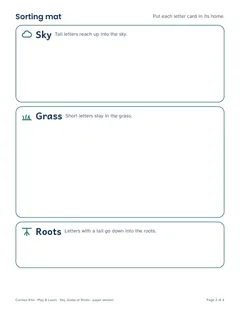
Every small letter lives in the sky, the grass or the roots, by its shape. Sort the letter cards onto the mat.
For grown-ups
What it builds: noticing the shapes of small letters: tall parts, tails and short letters.
Look for: does your child sort by shape: a tall part to the sky, a tail to the roots, short letters in the grass? Naming the letter is welcome, not needed.
Next: spell your child's name with the cards and sort those letters. Writing a letter from each home on the lines can come after.
Shape Detectives
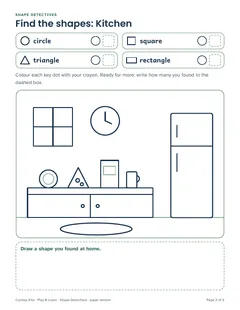
Five pictures to hunt in. Pick a crayon for each shape, then circle every one you can find.
For grown-ups
What it builds: finding and naming flat shapes, and telling them apart by their sides (two-dimensional shapes).
Look for: does your child match each shape to the key, or name it? Can they tell a square, with 4 sides the same, from a rectangle with 2 long sides and 2 short ones?
Next: hunt for the same shapes around your home, then build with blocks or boxes and find the shapes in what you built.
Colour Lab
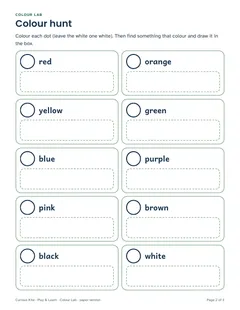
A colour hunt around your home, and a real paint-mixing page: guess first, then mix and see.
For grown-ups
What it builds: matching colours by looking, and seeing what happens when two colours mix.
Look for: does your child match colours by looking? Do they guess before mixing and say what they saw after? Naming the colour is a bonus, and a muddy colour is worth noticing too.
Next: mix real paint or food colouring in two cups, then add white a drop at a time. When does it change?
Bus Stop
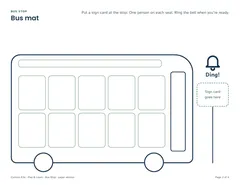
The sign says how many people get on. Your child moves that many onto the bus, rings the bell, and you count together to check.
For grown-ups
What it builds: counting, one count for each person (one-to-one correspondence), and knowing that the last number you say is how many are on the bus.
Look for: does your child touch or point to each person once as they count? Do they say the last number again at the end, as the answer?
Next: quick looks, a different skill: seeing how many without counting. Flash 1 to 3 dots on a card or a dice and ask "How many?" before there's time to count.
Pattern Parade

Line up animal cards in a pattern, leave a gap, and work out who comes next. Then clap and stamp it.
For grown-ups
What it builds: seeing the part of a pattern that repeats, and what comes next (patterning).
Look for: does your child say the parade in a steady beat and pick the animal that keeps it going? Can they show you the part that repeats?
Next: clap or stamp the parade together. Then try a longer pattern (duck, duck, frog), or put the gap in the middle, which is harder than a gap at the end.
Rhyme Fishing

Catch fish that rhyme. Say a word, then fish for the ones that end the same way.
For grown-ups
What it builds: hearing when two words end the same way (phonological awareness).
Look for: does your child hear that the ends match (cat, hat) and say so? Whole words only; there's no need to pull the sounds apart.
Next: three fish, two rhyme: which one doesn't? Or make up a silly word that rhymes with the last fish: cat, hat, zat.
Robot Route
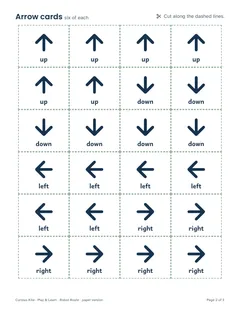
One of you is the robot. The other lays arrow cards to get the robot to the picnic. Then follow the arrows and see where you stop.
For grown-ups
What it builds: planning steps in order, then fixing a step that didn't work (coding).
Look for: does your child lay out more than one arrow before Go? When the robot stops somewhere else, do they change an arrow to fix it?
Next: add a puddle (a towel) to go around. Then look for a different way there, or a shorter one.
Seesaw

Guess which thing is heavier, then test it: in your hands, and on a coat-hanger balance.
For grown-ups
What it builds: comparing which of two things is heavier, by feel and on a balance (comparing mass).
Look for: does your child guess first, then test? Do they use words like heavier, lighter and the same?
Next: find something small that's heavy and something big that's light. Then see how many spoons balance an apple.
Mystery Box

Hide something in a box or bag. Give one clue at a time; the other person guesses. Then swap.
For grown-ups
What it builds: describing a thing by its shape, colour, feel and use (adjectives), and using clues to guess.
Look for: does your child use each clue to make a guess? On their turn, do they give describing words, like round, soft or heavy?
Next: give clues about feel only. Put a hand in the bag, no looking.
Silly Sentence Machine
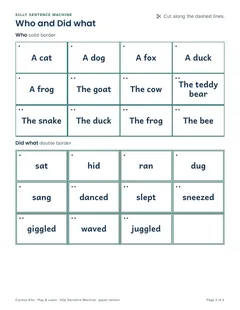
Flip three stacks of word cards to build a silly sentence. Read it together, then draw it. The picture comes after the reading.
For grown-ups
What it builds: reading a whole sentence and showing what it means (reading comprehension).
Look for: does your child read every word, not only the first? Does the drawing show what the words say (the cat *in* the hat, not beside it)? Rereading to check counts.
Next: add a describing word (tiny, huge) or a *because* card, or write your own word cards on the blanks.
Picnic Share

Share snacks fairly among picnic friends: real snacks on real plates first, or the cards on these pages. Then cut paper pizzas into halves and quarters.
For grown-ups
What it builds: sharing a group of things fairly and checking that every share is the same (fair sharing).
Look for: does your child give one at a time, or another fair way, and check by counting each plate? What do they say about leftovers? "Break it" or "save it" shows they're thinking about what's fair.
Next: cut paper pizzas into halves and quarters, and share 3 pizzas between 2 friends.
Fraction Kitchen
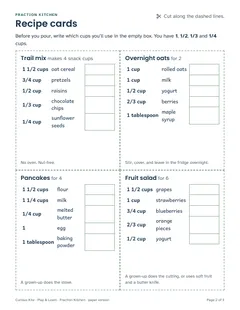
Measure for real with the cups in your kitchen. Before anyone pours, work out which cups make the amount.
For grown-ups
What it builds: making one amount from different fractions, with real measuring cups (equivalent fractions).
Look for: does your child name the cups before pouring, and check ("1/3 and 1/3 make 2/3")? Can they find a second way to make the same amount?
Next: double or halve a recipe before you cook, or make it for 6 people instead of 4.
Word Problem Case Files
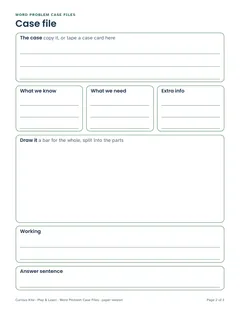
Every word problem is a case. Sort the clues first (what we know, what we need, what's extra), then solve it.
For grown-ups
What it builds: sorting what a problem tells you, what it asks and what's extra, before solving it (problem solving).
Look for: does your child find the question first, and say why a detail is extra? A drawing that shows the parts counts as much as the answer.
Next: try the two-step cases (5 to 8), or write a case for someone else with one extra clue to trick them.
Paragraph Architect

A paragraph has a frame: a topic sentence, details, and a closing sentence. Build one from cards, then write your own.
For grown-ups
What it builds: how a paragraph holds together: a topic sentence, details and a closing sentence (paragraph structure).
Look for: can your child say why the first sentence goes first? Do they spot words that signal an ending, like "In the end"?
Next: write a paragraph on the same frame about something your child cares about, or argue for something: the best season, the best pet.
Mystery Bags

Every bag holds the same number of blocks. Keep the balance level by doing the same thing to both sides, and find what's in a bag.
For grown-ups
What it builds: keeping both sides equal by doing the same thing to each, to find what's unknown (solving equations).
Look for: does your child say "same to both sides" before moving anything? Do they check by putting the number back into the puzzle?
Next: try the puzzles with bags on both sides (5 to 8), or make a puzzle for you to solve.
Au café
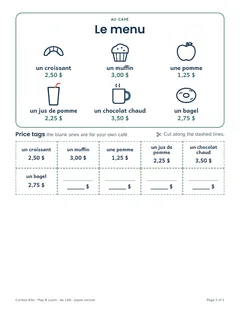
Play café in French: one person is the server, one is the customer. Listening comes first; your child speaks when ready.
For grown-ups
What it builds: understanding a café order in French and finding prices on a menu; listening first, speaking when ready (French as a second language).
Look for: does your child understand the order and find the price? Saying a line in French is welcome whenever they're ready, and accents don't have to be perfect.
Next: order two things and add the prices, or make price tags for things at home.
Clue Collector

Read a short mystery, mark the sentences that are clues, and work out who did it. Then explain how you know.
For grown-ups
What it builds: using sentences in a story as evidence for a conclusion (making inferences).
Look for: does your child point to a sentence as proof ("sentence 7 says…"), not only a feeling? Do they notice a clue that leads off the trail (a red herring)?
Next: write the explanation as a full sentence, or invent a mystery.
Number Line Zoom
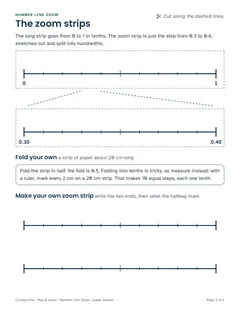
Fold a paper strip into tenths, then zoom in on one tenth to see hundredths. Place decimals and fractions where they live.
For grown-ups
What it builds: where decimals and fractions sit between whole numbers, in tenths and hundredths (decimal place value).
Look for: does your child say where a number goes before marking it, counting tenths from the nearest whole number? Do they use the halfway mark to check? Do 3/4 and 0.75 land on the same spot?
Next: put fractions and decimals on the same line, or try a line below zero, from −1 to 0.
Bridge Lab
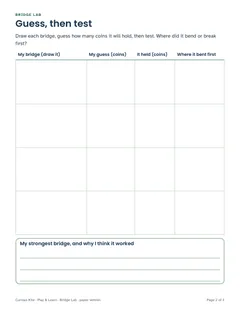
Build a bridge across a gap between two stacks of books, guess how many coins it will hold, then test it. A bridge that sags is information: it shows where to add support.
For grown-ups
What it builds: how shape makes a structure stronger: folds and triangles stiffen paper (structures).
Look for: does your child say *where* the bridge bent, and change that part next time? A test that fails is information: it shows where to add support.
Next: make the gap wider, or allow only 3 sheets of paper.
What's the Pattern?
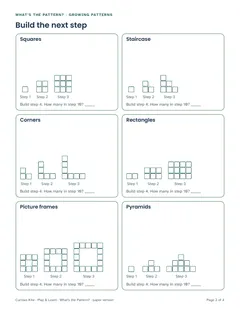
Growing patterns to build, and stick puzzles to solve. The answers are on the last page, for the grown-up.
For grown-ups
What it builds: finding the rule in a growing pattern and using it to predict (patterns and relationships).
Look for: can your child say the rule in words, like "each step is that many rows of that many"? Does their guess for step 10 come from the rule, not from counting? Ask "How did you see it?": more than one way is the interesting part.
Next: try the two-stick puzzles, or invent a growing pattern of their own.
Big Questions
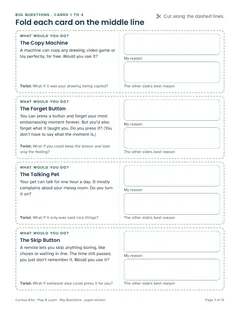
One big question, no right answer. Pick a side, give a reason, then find the best reason for the other side. It works at a dinner table.
For grown-ups
What it builds: giving a reason for a view, and making a fair case for the other side (reasoning).
Look for: does your child give a real reason, and try the other side fairly? Changing their mind after hearing the other side is part of the thinking, and so is keeping it, with a reason.
Next: swap: your child reads the card and you pick a side.
Make a Tiny Game
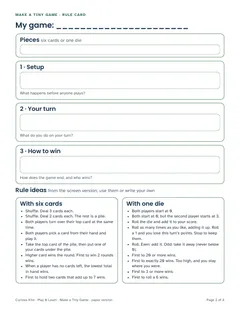
Pick your pieces, write three rules, then playtest your game and fix what goes wrong. A good game is one someone wants to play twice.
For grown-ups
What it builds: writing rules, testing them, and changing one rule to fix a problem (the design process).
Look for: does your child notice what went wrong (over in one turn, always a tie, the first player always wins) and change one rule to fix it? Losing a game is part of a game.
Next: add a twist rule ("A 1 beats a 6"), or make it work for three players.
Invent Something Ridiculous, and Useful
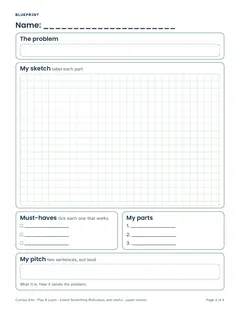
A design challenge. Each problem card has must-haves. Pick up to three parts, then test your idea against every must-have. Silly parts are welcome; making every must-have work is the goal.
For grown-ups
What it builds: designing to meet must-haves, testing an idea, and swapping a part that doesn't work (the engineering design process).
Look for: does your child give a reason for each must-have ("the pocket holds the picnic") and notice a catch ("the ladder is heavy, so the dragon can't fly")? Swapping a part is what designers do.
Next: add the card's extra must-have and a fourth part, then ask for the pitch out loud.
Print with a free account
Check your email. Choose a password from the link, then come back here and press Print. If this address already has an account, the email says how to sign in.